Tuesday, 13 October 2015

Alsace Pinot Noir

A first for me: Pinot Noir from Alsace. It's not supposed to be the region's forte, but this wine was impressive.

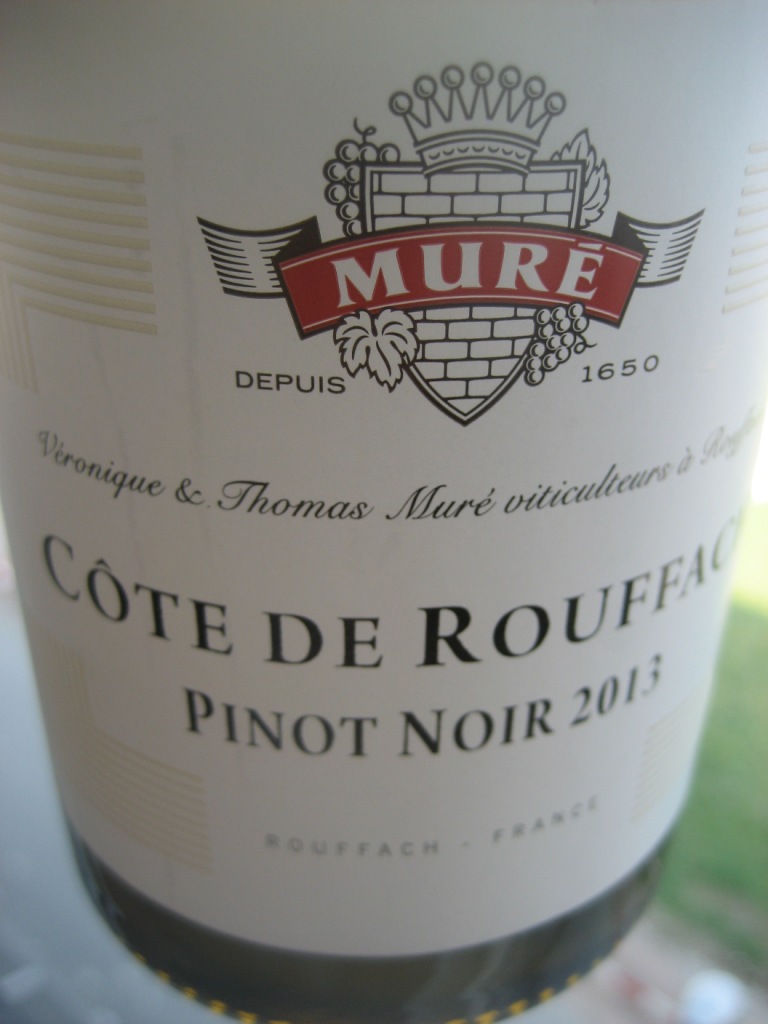
Domaine Muré, Côte de Rouffach, Pinot Noir 2013, Alsace
The town of Rouffach is situated just south of the village of Pfaffenheim where I spent summer 1998 working with a wine-growing family who, like Véronique and Thomas Muré (and his father René), practise biodynamic viticulture.

Translucent edges. Ruby with purplish suggestions. On the nose, quite reticent at first. So, in the decanter it goes for a couple of hours. Finally, something lovely emerges: blackcurrant and herbs, a hint of strawberry. Minty? Definitely chalky.

Bone dry in the mouth. This lends a chalky feel with considerable tannic grip. Feeling almost austere on the one hand, but overtly fruity on the other. Strawberry on day one, metamorphosing into blackcurrant on day two. Medium body, ample concentration. Exceedingly pure. Less mushroomy and "damp autumnal undergrowth" compared to some of its counterparts directly over the Rhine. In this sense, the wine is imbued with a different type of quality based more on fruit and purity. Maybe its personality is linear in the sense of being precise, direct and refreshing (but by no means simplistic). Any wood influence is barely perceptible and merely provides a skeleton-like structure for the fruit to take effect. The finish lingers for some time.

This is the lesser of three Muré Pinot Noirs - the other two in ascending order being "V" and "Clos Saint Landelin". "V" is grown in the Vorbourg grand cru vineyard. The abbreviation is used because Pinot Noir can't be classified as grand cru in Alsace. The renowned Clos Saint Landelin is a lieu-dit situated within the Vorbourg grand cru and owned exclusively by the Muré family.

Tuesday, 29 September 2015

Halbstück Réserve

I first wrote about this wine three years ago. This, my penultimate bottle, finally got to breathe some lovely, pure Basel air over a couple of days in August 2015.

Weingut Knipser, "Halbstück Réserve" Riesling trocken 2004, Pfalz
Matt golden with maybe some
rusty hints (see photo). All in all, very savoury and complex on the nose. This wine has clearly taken on additional layers and dimensions over the last three years. For example, I can now detect distinct notes of iron. The effect is quite stark and untamed. Pungent red berry fruit too, reminding me of raspberry ripple ice cream - which, in turn, takes me back to my childhood. Definitely some lime in there, along with blackcurrant maybe. Notwithstanding the aforementioned nuances, this is still smelling as fresh as a daisy, even after 11 years. Bone dry on the palate, reverberating between intense iron/iodine notes and raspberry/strawberry. If truth be told, feeling somewhat leaner than the nose would suggest - but imbued with an innate succulence, freshness and concentration of flavours. Which goes to show that a medium body and a mere 12 percent alcohol need not be an obstacle to complexity. The wine's various nuances seem to be in constant flux all the way through to a long finish.


Tuesday, 25 August 2015

Frühlingsplätzchen

Scraping a living has had to take priority over blogging in recent months. But I'm back - at least for now.

Weingut Emrich-Schönleber, Monzinger Frühlingsplätzchen Riesling trocken 2011, Nahe
This previously spent three years in my cellar. An attractive yellow tinge to this one. Peach, blossom and apricots on the nose. Then citrus (especially lime). A dense waxy note balances out these high tones.

More waxiness on the palate. Medium body at most, quite light-footed if truth be told. Bright with good acidity, yet at the same time dense and ripe. Long finish. Highly drinkable and mouthwatering, this wine is unashamedly fruit-driven (for exact constituents, see above) with only minimal minerality for now. And yet, it is an elegantly woven, complex package. Nominally, this is the Schönlebers' premier cru from Frühlingsplätzchen, but I fancy it would give most GCs, sorry GGs, a run for their money.

Tuesday, 30 June 2015

Paradiesgarten

Paradiesgarten is German for "Garden of Eden". It's also a lovely vineyard that overlooks the western tail-end of Deidesheim near the open-air swimming pool (I went for a refreshing dip there once, lovely place). A stone statue of a naked Eve also adorns the scenery.

Weingut von Winning, Erste Lage, Deidesheimer Paradiesgarten "Selection MAX" trocken 2014, Pfalz
The "Selection Max" is a nod to Swiss wine merchant Max Gerstl for whom the winery made this bottling.
Straw yellow in appearance. Surprising open on the nose for a wine this young. Predominantly white fruit notes - something along the lines of white peach, as well as yellow apple and pineapple. Almost translated like-for-like on the palate, along with some gooseberry. Light-medium body and plenty to commend this. A suggestion, or sense, of (tropical) sweetness, but this in itself is an endearing trait and not a weakness. Great for sipping (or swallowing in huge gulps).

Sunday, 21 June 2015

Pinot Rosé, Martin Wassmer

Time for some bubbly.

Weingut Martin Wassmer, Pinot Rosé Brut, Baden
I've always been mildly amused by Martin Wassmer's chutzpah at having a bottle label that is suspiciously reminiscent of a certain famous Champagne label. Salmon orange in appearance (see photo). Raspberry and melon aromas, biscuity hints. A little bit savoury. (Bacon?) Raspberry on the palate with a refreshing apple tartness that keeps my mouth watering. The raspberry is very pure and moreish. Perfect for mid-summer. This doesn't necessarily hit the true heights, but it's a pretty adamant, good-value sparkler that knows its worth. I might be inclined to get more.
Add caption

Saturday, 20 June 2015

Schneider from Weil

They say that familiarity breeds contempt. Now I wouldn't dream that for a minute when it comes to the wines of Claus Schneider from Weil. On the contrary, the quality that this down-to-earth family-run winery situated in Germany's most southwestern town produces is more than a little bit good. It's just that I seem to have gravitated away from them in recent years in favour of other wines from maybe a little further afield; I absolutely love the Rieslings of the Pfalz, for example. And yet, the grass isn't always greener on the other side. Just like I'm falling back in love with Gutedel - which, when grown in the right places, is in my opinion more than a match for, say, Silvaner - I'm also revisiting the wines from Weiler Schlipf - a vineyard I used to live barely a 10-minute walk away from when I first moved to this part of the world back in the year 2000. (I now live a 20-minute bike ride away.)

Weingut Claus Schneider, Weiler Weissburgunder trocken 2013, Baden
Very light beige, almost grey in appearance. Very minerally on the nose. No, seriously ... unadulterated minerals. That's the best descriptor I can find. It's not salty or iodine-like. It's minerally. If I wanted to sound less abstract but more macabre, I could also say that it's what I imagine crushed bones to smell of. The scent is very earthy, but the tones are light, if you know what I mean. This continues on the palate. Little in the way of obvious fruit, but a wine to be judged more on the basis of its elegant structure on the one hand and pure, stark minerally personality on the other. Light to medium body; long, satisfyingly dry finish. Not too dissimilar to a very good Chablis.

Monday, 27 April 2015

Riesling "R"

This is just tremendous.

Josten & Klein, Riesling "R" trocken, 2013, Mittelrhein
A very healthy yellow straw with a green tinge. Much riper than their entry-level Riesling. Wild with minerally notes, yellow stone fruit, hints of red apple and a certain herbal personality. Much of the above translates onto the palate. Anything but mainstream. Very complex. This is a lot less acidic than the estate wine. Very well integrated, very delicious and very drinkable. Wine of the year so far?