This is my last-ever blog entry on From Blackpool to Basel. It's hard to know where to begin, but the long and short of it is that, after no small amount of deliberation, I've decided to discontinue this blog and start afresh on a brand-new site called winetext (please click the embedded link). For an explanation of why I'm making this change, please refer to my first posting on this new site (again, please click the embedded link).
Don't worry, this isn't a cheerio but hopefully more a case of "see you again soon". I've decided not to import the entire contents of this blog across to the new site - everything I've written here will remain here for posterity. However, the basic gist of this blog - ramblings about wine - will continue at the new address (winetext dot net).
Cheers!
Thursday, 21 January 2016

Tuesday, 19 January 2016
Schwedhelm
 Schwarzer Herrgott and Am Schwarzen Herrgott are a strange anomaly - two vineyards that go by virtually the same name and sit cheek by jowl, next to each other in the Zellertal, or Zell Valley, but in completely different wine regions. Am Schwarzen Herrgott, situated geographically in Mölsheim in Rheinhessen, has earned fame in recent years on account of the eponymous grand cru Rieslings of Oliver Spanier at Weingut Battenfeld-Spanier. Its bedrock is of pure limestone, as is that of its neighbour with the slightly different name situated in the Pfalz, i.e. Schwarzer Herrgott, which owes its recent prominence to the endeavours of brothers Georg and Stephan Schwedhelm of Weingut Schwedhelm. Riesling is the star performer here, too. But the following wine isn't Riesling - that will have to wait for the time being.
Schwedhelm, Zellertal, Saint Laurent 2013, Pfalz
Very dark garnet/ruby. Fairly expressive on the nose. Dried herbs that become quite pronounced after a while in the glass, along with cherry, dark olives and and hints of dark berry fruit. Leathery notes complete the picture some 48 hours later. A savoury element on the palate - again evoking dark olives. Dark cherry too. As the wine washes around, it leaves behind a thin film on my tongue - a lovely sensation that reminds me of other wines from chalky, limestone soils. Cool in the mouth with keen tannins that lend good structure. Medium-bodied. A surprisingly good wine from the humble Saint Laurent varietal.
Tuesday, 5 January 2016
Nature
 The German social media wine scene recently imploded with talk about "natural wine" and what the term means. A mud-slinging match ensued.
Hansjörg Rebholz's dad and granddad were already making natural wine - or Naturwein - back in the post-war years of the 1940s and 50s. For them, Naturwein basically referred to wine that was neither subject to chaptalisation (the addition of sugar to increase alcoholic strength) nor underwent any other procedures in the cellar that would render it denuded of its natural character. This was a pioneering approach at the time. Naturwein also refers to many other factors, both in the vineyard and in the cellar. Humans play a central part, too.
Rebholz, Riesling vom Buntsandstein trocken 2014, Pfalz
Buntsandstein is German for coloured sandstone. This is one of the wines in Rebholz's "Terroir" range. Vivid straw in appearance. Iodine-like notes reminiscent of mineral water, otherwise quite reticent to be begin with. After 24 hours in the fridge with the cork back in, hints of lime, white peach and ginger show through. Still a fairly shy nose overall. Clear and citrusy on the palate - mostly lemon. The acidity cuts through everything, putting the wine on the proverbial knife edge. It manages to pull off the trick of exhibiting electric freshness without any bitterness whatsoever - a rare feat. It feels likes the tête de cuvée - the free-run juice obtained before pressing. Though I might be totally wrong. Whatever it is, the result is purity and digestibility.
Wednesday, 30 December 2015
Sometimes it's not just the wine
 Apart from the quality of the wine (or otherwise), the personality of the wine-grower can be a big turn-on or turn-off for me when it comes to making purchasing decisions. I'm often doubly satisfied if the wine I buy is from a winemaker who comes across as a modest, self-effacing, hard-working member of their profession. Conversely, I almost sub-consciously think twice about a very small number of producers - naming no names - who have got my back up for whatever reason in the past (although perceived arrogance is normally the common denominator). But let's not go there. Happily, I can easily count them on one hand.
I've never met Stefanie Weegmüller-Scherr, the winemaker at Weingut Weegmüller in Haardt, a neighbourhood of Neustadt an der Weinstrasse in the Pfalz, but thanks to power of social media, she has a certain profile that comes across well to me at least (and I don't mean in Facebook). While browsing in a wine shop a few weeks ago in the middle of Neustadt, this very thought not only crossed my mind but also informed my eventual purchasing choice.
Weegmüller, Der Elegante Riesling Kabinett trocken 2014, Pfalz
From the Haardter Mandelring vineyard site. The main village street in Haardt is also called Mandelring - a name that conjures up good memories in my mind thanks to a number of wine-fest visits many eons ago.
Typical straw with greenish reflexes. Clear on the nose, showing an airy concoction of pineapple, wet stone and apple (of the juicy red variety) with an imagined hint of sweetness in my mind's eye. Quite poised. Pineapple and apple again on the palate. Clean, pure and indeed elegant. This has enough of everything, but not an ounce too much. Spicy with good freshness. Not overly complicated, but full of goodness and refreshment. A mere 11.5 percent abv on the label means it's finished in no time.
Wednesday, 23 December 2015
No faffing around
 One of the things I love about the current German wine scene are the numerous hard-working families who still grow beautiful handcrafted wines at extremely customer-friendly prices. Some of the larger family operations on the flats of the Rhine valley in the Pfalz are also able to pull this off thanks in part to the relatively large volume of wine they are able to produce. If anything, this makes the quality they achieve all the more remarkable. Weingut Karl Pfaffmann are a case in point. I defy anyone to show me a better wine for EUR 6.49 (supermarket price).
Weingut Karl Pfaffmann, Riesling Silberberg trocken 2014, Pfalz
Beige in appearance. Lime, pineapple and white peach on the nose. Clear as a whistle on the palate, with the aforementioned flavours showing through again. Delicious, pure and unhurried. Dry-tasting, refreshing and digestible. Sure, this wine lives on its primary fruit to some extent, and I daresay it might come a cropper with the number-crunching trocken police who frown on residual sweetness above 4 g/l (notwithstanding the 9 g/l ceiling), but this is a lot of wine for your money. No faffing around.
Tuesday, 22 December 2015
Prüm
 "Jay-Jay" Prüm are a hallowed address on the Mosel. This is their entry-level wine.
Weingut Joh. Jos. Prüm, Riesling Kabinett 2013, Mosel
Very pale straw. Reticent at first, then opening up to show apple and slate. Puckering slate notes on entry. Appley as well. Light as a feather. Keen acidity lends ample refreshment and reduces the sweetness to a mere whisper on what is a long finish. Very digestible and gratifyingly easy to comprehend.
The label shows a drawing of the eponymous sun dial in the Wehlener Sonnenuhr ("Wehlen Sun Dial") vineyard.
Wednesday, 25 November 2015
From the Markgraf
 A villages-level Pinot Noir from Bodensee (Lake Constance), produced by a local member of the German nobility no less.
Markgraf von Baden, Schloss Salem, Birnauer Spätburgunder trocken 2013, Baden
Ruby with slightly purple edges. Quite obvious and up-front fruit. Blackcurrant and a some cherry too. Initially a little beetrooty and kitchy in a boiled sweets sort of way. Stemmy aromas counteract that to an extent. One day later and the impression on the nose has settled somewhat. The kitch has gone. Any wooden influence is completely hidden. I wouldn't be surprised if someone said this wine was aged in good old inox (stainless steel). Quite sappy in the mouth, again with an overridingly fruit-driven personality. Strawberry and raspberry. Plays quite a straight bat, as it were, in that it is easy to understand. The finish is refreshing. Should gain complexity with age, I daresay. For the moment an enjoyable and non-too-taxing wine.
Saturday, 21 November 2015
Le Kottabe
 A producer from Alsace whom I've heard a lot about.
Domaine Josmeyer, Riesling Le Kottabe 2012, Alsace
Pale straw with some slightly greenish hints. Expressive nose of candied lemon and a touch of grapefruit. Maybe also a medicinal, eucalyptus hint in there, too. The aroma promises more concentration than the palate delivers. In the mouth, the wine is quite featherweight and appley with a limpid, clear feel and a slight iodine note reminiscent of mineral water. Lovely citrus freshness holds things together and lends a good deal of length on the finish. The ultra dryness, the relative lightness and the neutrality of this wine would go well with sushi, I daresay.
Tuesday, 13 October 2015
Alsace Pinot Noir
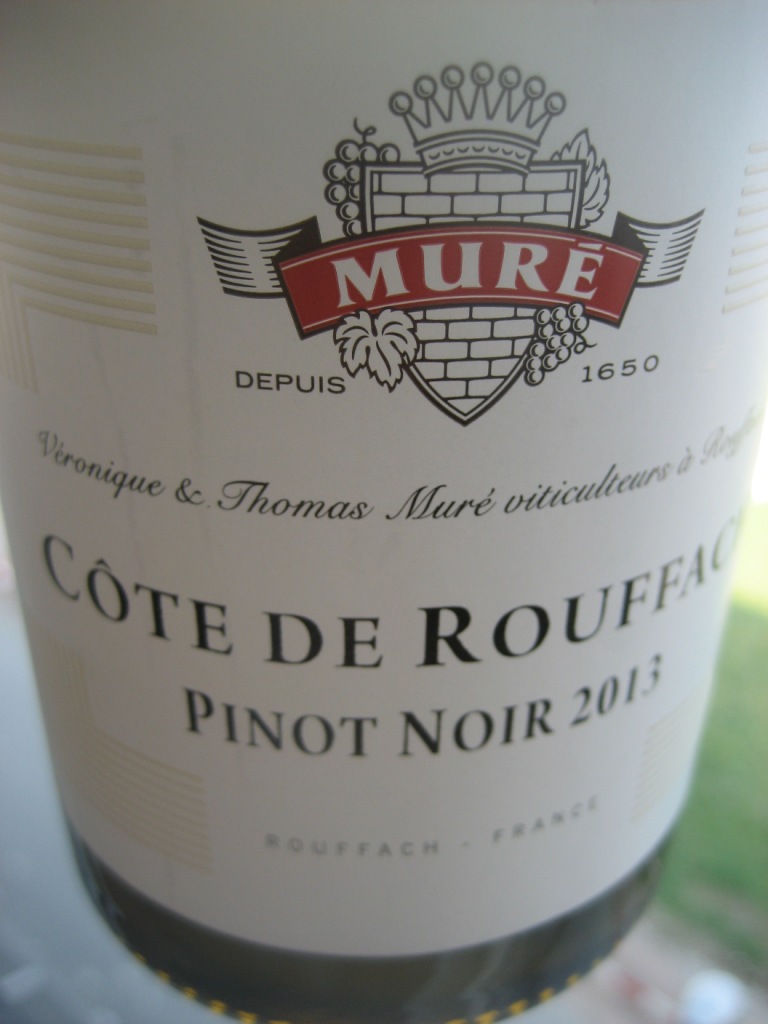 A first for me: Pinot Noir from Alsace. It's not supposed to be the region's forte, but this wine was impressive.
Domaine Muré, Côte de Rouffach, Pinot Noir 2013, Alsace
The town of Rouffach is situated just south of the village of Pfaffenheim where I spent summer 1998 working with a wine-growing family who, like Véronique and Thomas Muré (and his father René), practise biodynamic viticulture.
Translucent edges. Ruby with purplish suggestions. On the nose, quite reticent at first. So, in the decanter it goes for a couple of hours. Finally, something lovely emerges: blackcurrant and herbs, a hint of strawberry. Minty? Definitely chalky.
Bone dry in the mouth. This lends a chalky feel with considerable tannic grip. Feeling almost austere on the one hand, but overtly fruity on the other. Strawberry on day one, metamorphosing into blackcurrant on day two. Medium body, ample concentration. Exceedingly pure. Less mushroomy and "damp autumnal undergrowth" compared to some of its counterparts directly over the Rhine. In this sense, the wine is imbued with a different type of quality based more on fruit and purity. Maybe its personality is linear in the sense of being precise, direct and refreshing (but by no means simplistic). Any wood influence is barely perceptible and merely provides a skeleton-like structure for the fruit to take effect. The finish lingers for some time.
This is the lesser of three Muré Pinot Noirs - the other two in ascending order being "V" and "Clos Saint Landelin". "V" is grown in the Vorbourg grand cru vineyard. The abbreviation is used because Pinot Noir can't be classified as grand cru in Alsace. The renowned Clos Saint Landelin is a lieu-dit situated within the Vorbourg grand cru and owned exclusively by the Muré family.
Tuesday, 29 September 2015
Halbstück Réserve

Weingut Knipser, "Halbstück Réserve" Riesling trocken 2004, Pfalz
Matt golden with maybe some
rusty hints (see photo). All in all, very savoury and complex on the nose. This wine has clearly taken on additional layers and dimensions over the last three years. For example, I can now detect distinct notes of iron. The effect is quite stark and untamed. Pungent red berry fruit too, reminding me of raspberry ripple ice cream - which, in turn, takes me back to my childhood. Definitely some lime in there, along with blackcurrant maybe. Notwithstanding the aforementioned nuances, this is still smelling as fresh as a daisy, even after 11 years. Bone dry on the palate, reverberating between intense iron/iodine notes and raspberry/strawberry. If truth be told, feeling somewhat leaner than the nose would suggest - but imbued with an innate succulence, freshness and concentration of flavours. Which goes to show that a medium body and a mere 12 percent alcohol need not be an obstacle to complexity. The wine's various nuances seem to be in constant flux all the way through to a long finish.

Tuesday, 25 August 2015
Frühlingsplätzchen
 Scraping a living has had to take priority over blogging in recent months. But I'm back - at least for now.
Weingut Emrich-Schönleber, Monzinger Frühlingsplätzchen Riesling trocken 2011, Nahe
This previously spent three years in my cellar. An attractive yellow tinge to this one. Peach, blossom and apricots on the nose. Then citrus (especially lime). A dense waxy note balances out these high tones.
More waxiness on the palate. Medium body at most, quite light-footed if truth be told. Bright with good acidity, yet at the same time dense and ripe. Long finish. Highly drinkable and mouthwatering, this wine is unashamedly fruit-driven (for exact constituents, see above) with only minimal minerality for now. And yet, it is an elegantly woven, complex package. Nominally, this is the Schönlebers' premier cru from Frühlingsplätzchen, but I fancy it would give most GCs, sorry GGs, a run for their money.
Tuesday, 30 June 2015
Paradiesgarten
 Paradiesgarten is German for "Garden of Eden". It's also a lovely vineyard that overlooks the western tail-end of Deidesheim near the open-air swimming pool (I went for a refreshing dip there once, lovely place). A stone statue of a naked Eve also adorns the scenery.
Weingut von Winning, Erste Lage, Deidesheimer Paradiesgarten "Selection MAX" trocken 2014, Pfalz
The "Selection Max" is a nod to Swiss wine merchant Max Gerstl for whom the winery made this bottling.
Straw yellow in appearance. Surprising open on the nose for a wine this young. Predominantly white fruit notes - something along the lines of white peach, as well as yellow apple and pineapple. Almost translated like-for-like on the palate, along with some gooseberry. Light-medium body and plenty to commend this. A suggestion, or sense, of (tropical) sweetness, but this in itself is an endearing trait and not a weakness. Great for sipping (or swallowing in huge gulps).
Sunday, 21 June 2015
Pinot Rosé, Martin Wassmer
 Time for some bubbly.
Weingut Martin Wassmer, Pinot Rosé Brut, Baden
I've always been mildly amused by Martin Wassmer's chutzpah at having a bottle label that is suspiciously reminiscent of a certain famous Champagne label. Salmon orange in appearance (see photo). Raspberry and melon aromas, biscuity hints. A little bit savoury. (Bacon?) Raspberry on the palate with a refreshing apple tartness that keeps my mouth watering. The raspberry is very pure and moreish. Perfect for mid-summer. This doesn't necessarily hit the true heights, but it's a pretty adamant, good-value sparkler that knows its worth. I might be inclined to get more.
 |
| Add caption |
Saturday, 20 June 2015
Schneider from Weil
 They say that familiarity breeds contempt. Now I wouldn't dream that for a minute when it comes to the wines of Claus Schneider from Weil. On the contrary, the quality that this down-to-earth family-run winery situated in Germany's most southwestern town produces is more than a little bit good. It's just that I seem to have gravitated away from them in recent years in favour of other wines from maybe a little further afield; I absolutely love the Rieslings of the Pfalz, for example. And yet, the grass isn't always greener on the other side. Just like I'm falling back in love with Gutedel - which, when grown in the right places, is in my opinion more than a match for, say, Silvaner - I'm also revisiting the wines from Weiler Schlipf - a vineyard I used to live barely a 10-minute walk away from when I first moved to this part of the world back in the year 2000. (I now live a 20-minute bike ride away.)
Weingut Claus Schneider, Weiler Weissburgunder trocken 2013, Baden
Very light beige, almost grey in appearance. Very minerally on the nose. No, seriously ... unadulterated minerals. That's the best descriptor I can find. It's not salty or iodine-like. It's minerally. If I wanted to sound less abstract but more macabre, I could also say that it's what I imagine crushed bones to smell of. The scent is very earthy, but the tones are light, if you know what I mean. This continues on the palate. Little in the way of obvious fruit, but a wine to be judged more on the basis of its elegant structure on the one hand and pure, stark minerally personality on the other. Light to medium body; long, satisfyingly dry finish. Not too dissimilar to a very good Chablis.
Monday, 27 April 2015
Riesling "R"
 This is just tremendous.
Josten & Klein, Riesling "R" trocken, 2013, Mittelrhein
A very healthy yellow straw with a green tinge. Much riper than their entry-level Riesling. Wild with minerally notes, yellow stone fruit, hints of red apple and a certain herbal personality. Much of the above translates onto the palate. Anything but mainstream. Very complex. This is a lot less acidic than the estate wine. Very well integrated, very delicious and very drinkable. Wine of the year so far?
Sunday, 26 April 2015
Josten & Klein
 My goodness, this is hardcore.
As a preliminary, I would implore anyone who has a bottle of this to GIVE IT ENOUGH AIR. I can't emphasis that enough.
Josten & Klein won the Gault Millau award of Newcomers of the Year in Germany a couple of years ago, if I recall correctly. Their cellars are based in Remagen, near the apex of where the rivers Rhine and Ahr meet. This is no coincidence as Josten & Klein have vineyard holdings in both the Ahr and the Mittelrhein regions.
Josten & Klein, Riesling trocken 2013, Mittelrhein
The white wines invariably come from the Rhine, the reds from the Ahr. Light straw with a greenish tinge. Already, the appearance gives a slight suggestion of what lies ahead. Mint leaves on the nose, with a greenish minerally hint that's hard to describe, along with citrus and maybe a suggestion of blood orange. What greet me on the palate are iodine notes reminiscent of mineral water. Anyone who lives in the Basel area will have heard of or drunk Eptinger mineral water at some stage. Not necessarily my cup of tea, but that extreme iodine characteristic of Eptinger is certainly there. Bone dry, and no fruit is discernible at all. Instead, we have acidity on the very edge of what could be considered harsh. Some might describe it as being shrill and sour. However ... this is a wine that grows on me. The acidity levels are borderline, yet the more I sip, the more I like. This is electrifying. The 2013 vintage is challenging even for acid hounds. The acidity in this wine is incredible. And yet, ultimately, the wine is not only balanced but ... exhilarating.
Saturday, 25 April 2015
Farmer Giles
 That's the nickname my wife and I gave Hanspeter Ziereisen after tasting his wines back in early 2010. Most who grew up in the UK would understand what we mean. For all others, it's simply our affectionate way of referring to one of Baden's most brilliant wine-growers. I would imagine the original "Farmer Giles" to be a down-to-earth, red-nosed, hearty, bucolic sort of character. No idea whether how he would react if he ever read this, but, let's face it: Hanspeter Ziereisen looks, dresses and talks like a farmer. I mean this in a good way. Down here, we're more than a little bit proud of the Ziereisens.
It was a while since I last tried this. One bottle still to go after this one.
Weingut Ziereisen, Spätburgunder "Schulen" 2008, Baden, Germany
Cherry-coloured, or pale ruby as it were. Dark cherries on the nose, with resiny, stemmy notes. The whiff is quite perfumy now, yet still very delicate and fresh. Beautiful cedar aromas. Elegant. Minerally on the nose with assertive tannins. Not necessarily silky - this has more of a rustic than elegant charm. Very fresh and vital still.
Tuesday, 7 April 2015
Bürklin-Wolf Riesling
 No point beating around the bush: this is my type of wine.
Weingut Dr. Bürklin-Wolf, Riesling trocken 2013, Pfalz
Vivid yellowish straw in appearance. You can already tell that this has stuffing. Beautiful succulent peach along with hints of apricot. Hm, you can't beat the Pfalz for a bit of peach and apricot. Generous as it washes away inside my mouth. On the one hand showing a dark spicy, earthy characteristic, on the other fresh yet well-integrated acidity. Very clean. If anything, purer and a little more austere on the second day, but essentially a wine that is easy to understand. This is their estate wine and as good a calling call as any.
Monday, 6 April 2015
Maltesergarten
 The vineyards of Schlatt are a little unusual in Markgräflerland in that they are situated on what are otherwise the valley flats, albeit on a gentle incline. You could barely call it a hill. The nursery slopes of the Black Forest are still a good few kilometres away. To the west nondescript asparagus fields, to the east the spa town of Bad Krozingen. And yet, Martin Wassmer produces some of the region's best Pinots Noirs from his Maltesergarten holdings.
Weingut Martin Wassmer, Schlatter Maltesergarten Spätburgunder trocken 2010 , Baden
Light ruby with slight brownish suggestions on the rim. A whiff of raspberry along with a savoury, earthy, mushroomy suggestion of undergrowth. Ripe and dense, if a little reticent (the wine needs up two full days to open up). Well-integrated oak, generating a savoury "wet wood" aroma. A fair amount of grip on the palate, yet the tannins are velvety. The overall effect is elegant yet concentrated. Good acidity, as one would expect for 2010. Just a great bottle of Pinot with a lot of sophistication for the price bracket (around 15 euros).
Sunday, 5 April 2015
Max Geitlinger
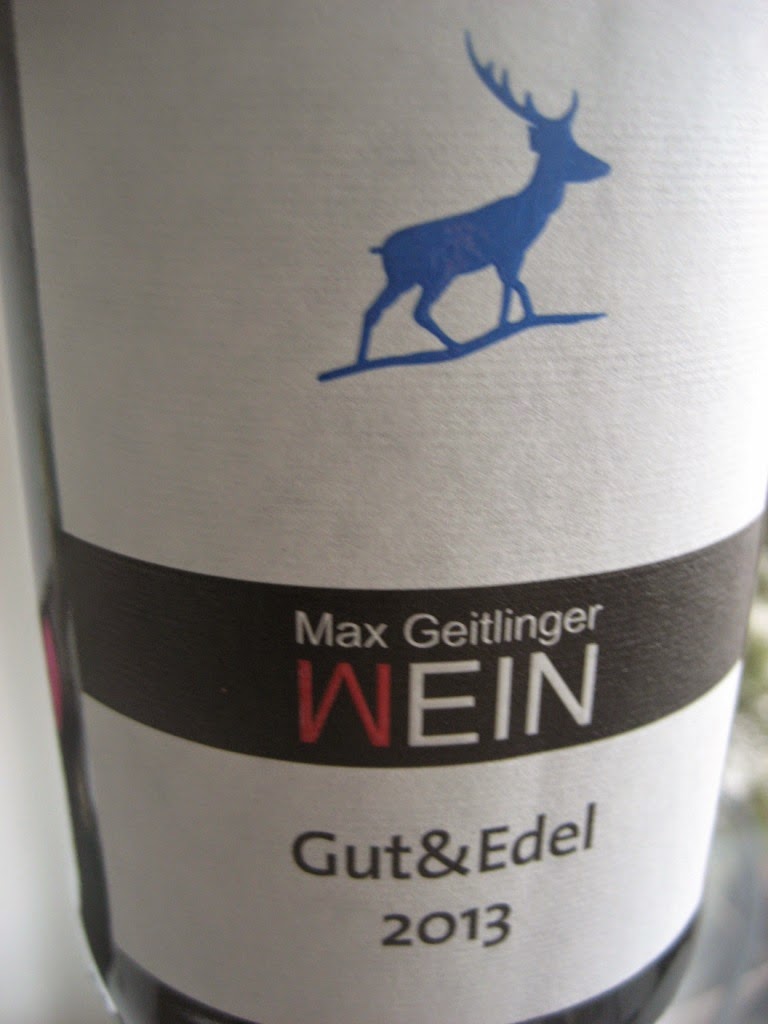 This is a new local name I've only heard of recently. Great label. The winery adjoins an interesting-looking restaurant that I'd like to discover some time soon.
Max Geitlinger, Gut & Edel 2013, Baden
Good and noble ... Gutedel, of course. A healthy yellowish straw colour. Clear on the nose with a yellow-fruit characteristic, even some melon. An ever-so-slightly nutty tone along with a squeeze of lime. Very pure on the palate. Fruity, yes, but also very elegant. Low alcohol (11 percent) but with quite a bit of interesting intrinsic concentration. Very classy for just six euros.
Subscribe to:
Posts (Atom)
