Wednesday, 30 December 2015

Sometimes it's not just the wine

Apart from the quality of the wine (or otherwise), the personality of the wine-grower can be a big turn-on or turn-off for me when it comes to making purchasing decisions. I'm often doubly satisfied if the wine I buy is from a winemaker who comes across as a modest, self-effacing, hard-working member of their profession. Conversely, I almost sub-consciously think twice about a very small number of producers - naming no names - who have got my back up for whatever reason in the past (although perceived arrogance is normally the common denominator). But let's not go there. Happily, I can easily count them on one hand.

I've never met Stefanie Weegmüller-Scherr, the winemaker at Weingut Weegmüller in Haardt, a neighbourhood of Neustadt an der Weinstrasse in the Pfalz, but thanks to power of social media, she has a certain profile that comes across well to me at least (and I don't mean in Facebook). While browsing in a wine shop a few weeks ago in the middle of Neustadt, this very thought not only crossed my mind but also informed my eventual purchasing choice.

Weegmüller, Der Elegante Riesling Kabinett trocken 2014, Pfalz
From the Haardter Mandelring vineyard site. The main village street in Haardt is also called Mandelring - a name that conjures up good memories in my mind thanks to a number of wine-fest visits many eons ago.

Typical straw with greenish reflexes. Clear on the nose, showing an airy concoction of pineapple, wet stone and apple (of the juicy red variety) with an imagined hint of sweetness in my mind's eye. Quite poised. Pineapple and apple again on the palate. Clean, pure and indeed elegant. This has enough of everything, but not an ounce too much. Spicy with good freshness. Not overly complicated, but full of goodness and refreshment. A mere 11.5 percent abv on the label means it's finished in no time.

Wednesday, 23 December 2015

No faffing around

One of the things I love about the current German wine scene are the numerous hard-working families who still grow beautiful handcrafted wines at extremely customer-friendly prices. Some of the larger family operations on the flats of the Rhine valley in the Pfalz are also able to pull this off thanks in part to the relatively large volume of wine they are able to produce. If anything, this makes the quality they achieve all the more remarkable. Weingut Karl Pfaffmann are a case in point. I defy anyone to show me a better wine for EUR 6.49 (supermarket price).

Weingut Karl Pfaffmann, Riesling Silberberg trocken 2014, Pfalz
Beige in appearance. Lime, pineapple and white peach on the nose. Clear as a whistle on the palate, with the aforementioned flavours showing through again. Delicious, pure and unhurried. Dry-tasting, refreshing and digestible. Sure, this wine lives on its primary fruit to some extent, and I daresay it might come a cropper with the number-crunching trocken police who frown on residual sweetness above 4 g/l (notwithstanding the 9 g/l ceiling), but this is a lot of wine for your money. No faffing around.

Tuesday, 22 December 2015

Prüm

"Jay-Jay" Prüm are a hallowed address on the Mosel. This is their entry-level wine.

Weingut Joh. Jos. Prüm, Riesling Kabinett 2013, Mosel
Very pale straw. Reticent at first, then opening up to show apple and slate. Puckering slate notes on entry. Appley as well. Light as a feather. Keen acidity lends ample refreshment and reduces the sweetness to a mere whisper on what is a long finish. Very digestible and gratifyingly easy to comprehend.

The label shows a drawing of the eponymous sun dial in the Wehlener Sonnenuhr ("Wehlen Sun Dial") vineyard.

Wednesday, 25 November 2015

From the Markgraf

A villages-level Pinot Noir from Bodensee (Lake Constance), produced by a local member of the German nobility no less.

Markgraf von Baden, Schloss Salem, Birnauer Spätburgunder trocken 2013, Baden
Ruby with slightly purple edges. Quite obvious and up-front fruit. Blackcurrant and a some cherry too. Initially a little beetrooty and kitchy in a boiled sweets sort of way. Stemmy aromas counteract that to an extent. One day later and the impression on the nose has settled somewhat. The kitch has gone. Any wooden influence is completely hidden. I wouldn't be surprised if someone said this wine was aged in good old inox (stainless steel). Quite sappy in the mouth, again with an overridingly fruit-driven personality. Strawberry and raspberry. Plays quite a straight bat, as it were, in that it is easy to understand. The finish is refreshing. Should gain complexity with age, I daresay. For the moment an enjoyable and non-too-taxing wine.

Saturday, 21 November 2015

Le Kottabe

A producer from Alsace whom I've heard a lot about.

Domaine Josmeyer, Riesling Le Kottabe 2012, Alsace
Pale straw with some slightly greenish hints. Expressive nose of candied lemon and a touch of grapefruit. Maybe also a medicinal, eucalyptus hint in there, too. The aroma promises more concentration than the palate delivers. In the mouth, the wine is quite featherweight and appley with a limpid, clear feel and a slight iodine note reminiscent of mineral water. Lovely citrus freshness holds things together and lends a good deal of length on the finish. The ultra dryness, the relative lightness and the neutrality of this wine would go well with sushi, I daresay.

Tuesday, 13 October 2015

Alsace Pinot Noir

A first for me: Pinot Noir from Alsace. It's not supposed to be the region's forte, but this wine was impressive.

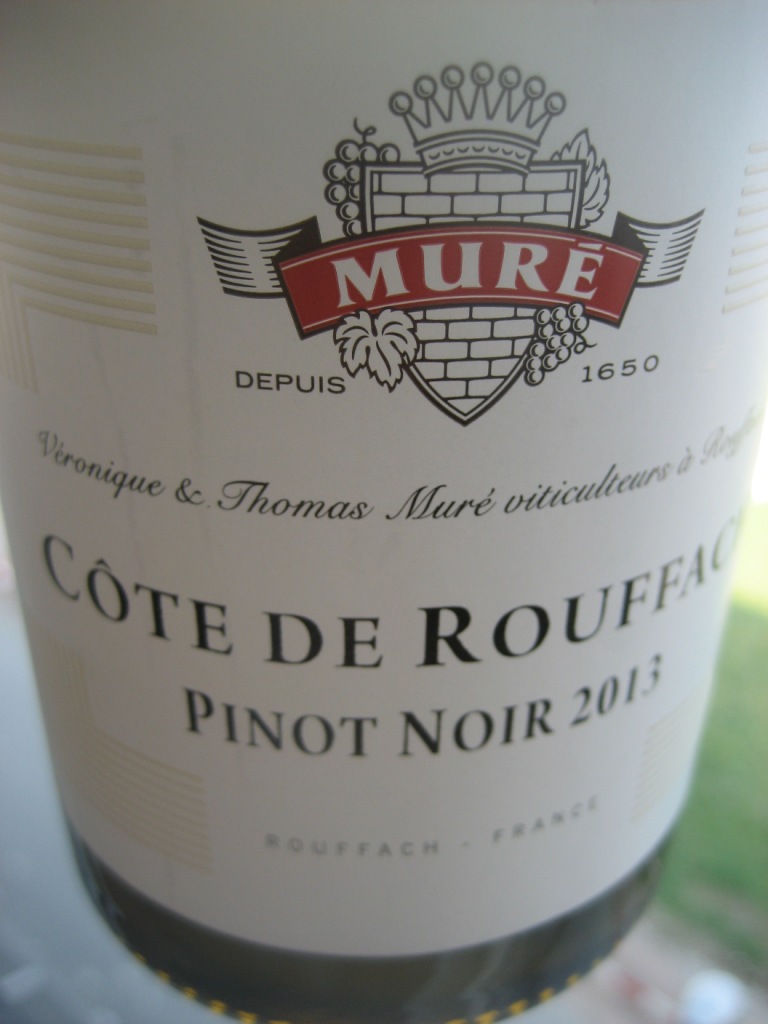
Domaine Muré, Côte de Rouffach, Pinot Noir 2013, Alsace
The town of Rouffach is situated just south of the village of Pfaffenheim where I spent summer 1998 working with a wine-growing family who, like Véronique and Thomas Muré (and his father René), practise biodynamic viticulture.

Translucent edges. Ruby with purplish suggestions. On the nose, quite reticent at first. So, in the decanter it goes for a couple of hours. Finally, something lovely emerges: blackcurrant and herbs, a hint of strawberry. Minty? Definitely chalky.

Bone dry in the mouth. This lends a chalky feel with considerable tannic grip. Feeling almost austere on the one hand, but overtly fruity on the other. Strawberry on day one, metamorphosing into blackcurrant on day two. Medium body, ample concentration. Exceedingly pure. Less mushroomy and "damp autumnal undergrowth" compared to some of its counterparts directly over the Rhine. In this sense, the wine is imbued with a different type of quality based more on fruit and purity. Maybe its personality is linear in the sense of being precise, direct and refreshing (but by no means simplistic). Any wood influence is barely perceptible and merely provides a skeleton-like structure for the fruit to take effect. The finish lingers for some time.

This is the lesser of three Muré Pinot Noirs - the other two in ascending order being "V" and "Clos Saint Landelin". "V" is grown in the Vorbourg grand cru vineyard. The abbreviation is used because Pinot Noir can't be classified as grand cru in Alsace. The renowned Clos Saint Landelin is a lieu-dit situated within the Vorbourg grand cru and owned exclusively by the Muré family.

Tuesday, 29 September 2015

Halbstück Réserve

I first wrote about this wine three years ago. This, my penultimate bottle, finally got to breathe some lovely, pure Basel air over a couple of days in August 2015.

Weingut Knipser, "Halbstück Réserve" Riesling trocken 2004, Pfalz
Matt golden with maybe some
rusty hints (see photo). All in all, very savoury and complex on the nose. This wine has clearly taken on additional layers and dimensions over the last three years. For example, I can now detect distinct notes of iron. The effect is quite stark and untamed. Pungent red berry fruit too, reminding me of raspberry ripple ice cream - which, in turn, takes me back to my childhood. Definitely some lime in there, along with blackcurrant maybe. Notwithstanding the aforementioned nuances, this is still smelling as fresh as a daisy, even after 11 years. Bone dry on the palate, reverberating between intense iron/iodine notes and raspberry/strawberry. If truth be told, feeling somewhat leaner than the nose would suggest - but imbued with an innate succulence, freshness and concentration of flavours. Which goes to show that a medium body and a mere 12 percent alcohol need not be an obstacle to complexity. The wine's various nuances seem to be in constant flux all the way through to a long finish.